Tidal Pulls the Plug: Inside the First Major Streamer to Ban AI Music Outright

For most of 2026, the streaming world's response to the AI music flood has been a shrug wrapped in a label. Tag it, demonetize it, bury it in the algorithm... but still leave it up. On Tuesday, Tidal finally stopped shrugging.
Starting December 9, Tidal will reject and remove any track generated entirely by AI tools, and it will refuse distributor deliveries whose metadata says a song was made solely with generative AI. Songs where AI was a tool in a human's hands are still welcome. Songs where AI was the artist are not. It's the first time one of the big subscription streamers has drawn a hard line, and it lands the same year the AI tide finally became impossible to ignore. (Music Business Worldwide, Digital Music News)
The numbers behind the decision
Tidal didn't just announce the ban. It showed its work, in a stark black-and-white graphic that reads like a crime scene report:
- ~27 million tracks, about 6% of Tidal's whole catalog, already carry its AI badge.
- 43% of all tracks delivered over the past 90 days earned that badge. On November 6, the single worst day yet, fully AI tracks made up more than 60% of the day's deliveries.
- 94% of AI-badged tracks trace back to one tool: Suno.
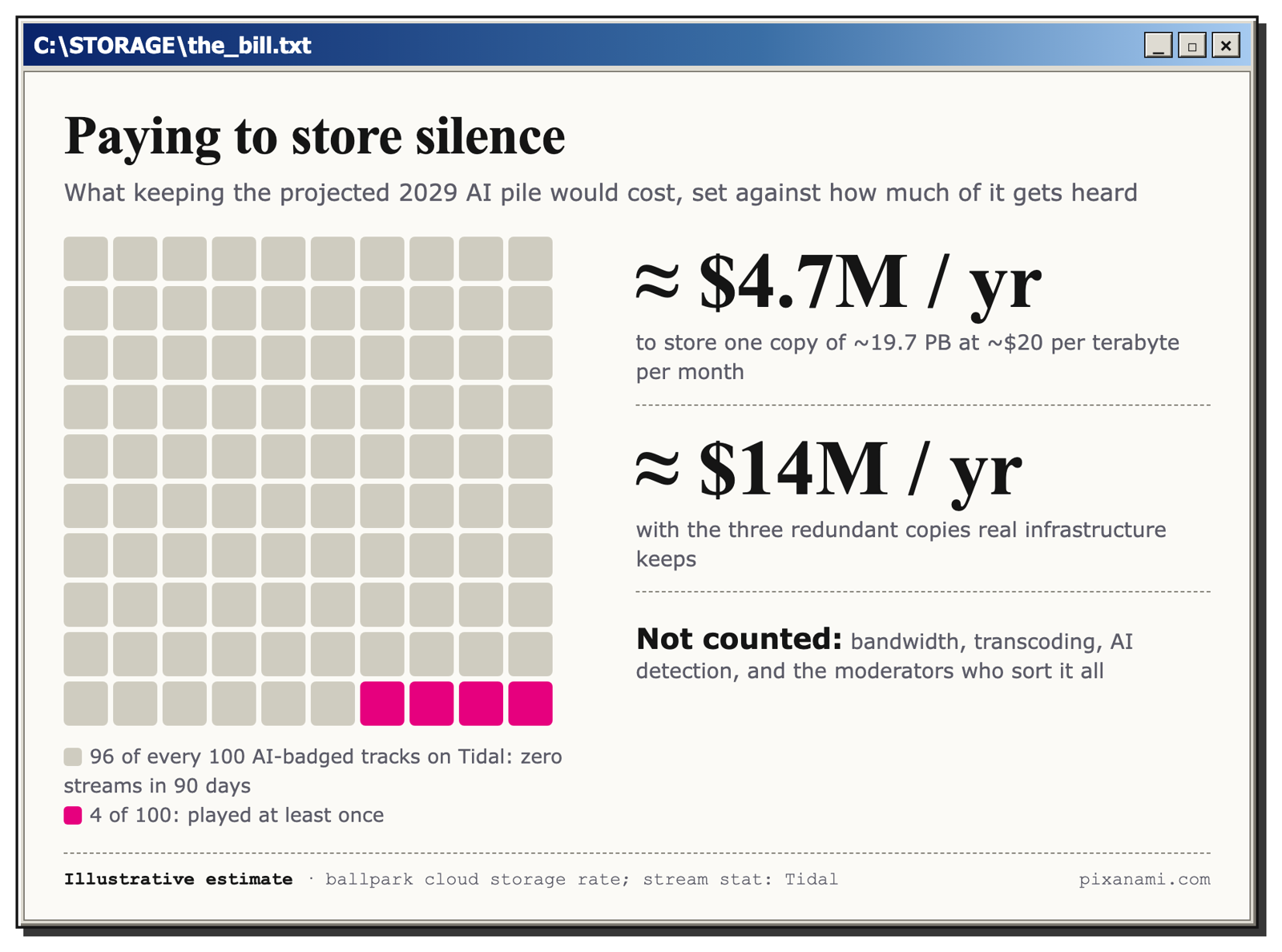
- 96% of AI-badged tracks got zero streams in the last 90 days.
- Roughly 66,000 AI tracks have already been automatically pulled for suspected artist-name impersonation (trade coverage puts it at "more than 65,000").
(Music Business Worldwide, Digital Music News, Variety, The Hollywood Reporter)
Sit with that 96% figure for a second. Nearly half of what's being shipped to Tidal is machine-made, and almost none of it is being heard. This isn't a wave of AI hits displacing human ones. It's a landfill. The material sits in the catalog, clogs the new-release pipes, games search results, and in its worst form borrows real artists' names to siphon streams. Tidal's pitch to musicians boils down to one line: if you make music, it "won't be buried under tracks no one asked for."
How Tidal got here
This didn't come out of nowhere. Back in June 2026, Tidal rolled out its first AI policy: fully AI-generated tracks got a visible badge in the app and were cut off from streaming royalties and direct-to-fan sales, though they stayed playable. Labeling plus demonetization was supposed to take the profit out of slop farming. Five months later, Tidal's own numbers suggest it didn't slow the deliveries. The share of AI uploads kept climbing anyway. (Variety, The Next Web)
That's the most telling part of the story. Demonetizing AI music didn't stop people from uploading it. When generating a song costs seconds and pennies, you don't need it to earn on Tidal. You only need it to exist on enough platforms that something somewhere pays out, or to sit in a catalog as a vehicle for streaming fraud.
How detection works: Tidal relies on two layers. The first is distributor metadata: if the delivery says "made solely with AI," it bounces. The second is audio analysis from Ircam Amplify, the commercial arm of the famed Paris research institute IRCAM. Ircam Amplify says its system can scan more than 250,000 tracks an hour with a false-positive rate below 0.02%. That number will get tested hard once real artists' livelihoods depend on it. (Music Business Worldwide)
An open question: It isn't fully clear yet what happens to the 27 million tracks already badged. Tidal's statement focuses on rejecting and removing submissions going forward. Digital Music News reports that the existing AI catalog is being purged too. Expect clarity, and possibly some angry distributors, when December 9 arrives. (Digital Music News)
Where the line sits: "Wholly AI" means a track that is the sole output of a tool like Suno or Google's Lyria. A producer using AI stem separation, an AI mastering chain, or a generated texture inside a song they wrote and arranged is still in the clear. That's a sensible line in principle. In practice, the space between "AI-assisted" and "AI-generated" is where the arguments of 2027 will happen.
Who else is drawing lines?
Tidal is the first major streamer to ban fully AI music, but it isn't the first platform. Here's where everyone stands as of late November 2026:
Bandcamp: banned since January
Bandcamp got there first. On January 13, 2026, in a post titled "Keeping Bandcamp Human," it banned music generated wholly or in substantial part by AI, along with any use of AI to impersonate other artists or styles. Enforcement leans on user reports and human moderators, and Bandcamp reserves the right to pull anything it suspects is AI-made. For a platform built on fans buying directly from artists, it was an easy call that still took guts. (Bandcamp, Digital Music News, Mixmag)
Beatport: reportedly closed to fully AI tracks
The DJ store has reportedly stopped selling fully or mostly AI-generated music, making it the second storefront to take a hard stance. (Mastering The Mix)
Deezer: the detective, not (yet) the bouncer
No streamer has done more to measure the problem than Deezer. Its intake numbers tell the story of 2026 by themselves: about 60,000 fully AI tracks a day in January (39% of uploads), 75,000 in April (44%), and roughly 90,000 a day by June, when AI uploads topped 50% of daily deliveries for the first time. Deezer says it detected more than 42 million AI tracks between January 2025 and August 2026. Yet AI music makes up just 1–3% of actual streams, and Deezer says up to 85% of the streams AI tracks did get in 2025 were fraudulent. (Deezer Newsroom, Deezer Newsroom, TechCrunch, Music Business Worldwide)
Deezer tags fully AI tracks, keeps them off algorithmic and editorial playlists, demonetizes fraudulent streams, and since July has been deleting AI tracks that are tied to fraud or that have gone unplayed for six months. It also plans to let listeners block AI music from search by the end of the year. It hasn't banned AI music outright, at least not yet. (Digital Music News, Music Business Worldwide)
Qobuz: tag, demonetize, remove the frauds
The audiophile's streamer announced its own in-house detection system in February 2026 and started showing AI tags in the app on September 24. AI-tagged streams are excluded from royalty payouts, and Qobuz reserves the right to remove impersonators and stream manipulators. Its own data says 60% of tracks identified as AI-generated were flagged as fraudulent. (Qobuz, Music Business Worldwide)
Spotify: AI-friendly, spam-hostile
Spotify has said plainly that it won't punish artists for using AI. It goes after abuse instead: unauthorized voice clones, spam uploads, and fake profiles. It removed 75 million "spammy" tracks over the 12 months leading to September 2025, has since pulled more than 50 million slop and spam tracks out of recommendations, and in August 2026 started putting "AI Persona" badges on artist profiles it believes are AI-generated identities. Artists can disclose AI use in song credits through a DDEX-backed standard, and Spotify is adding account controls so artists can block fake releases from showing up on their pages. (Music Business Worldwide, MusicRadar, Stereogum, Digital Music News)
YouTube Music: two flavors of label
In October 2026, YouTube Music started labeling tracks as "Fully Gen AI" or "Partly Gen AI," using both partner disclosures and its own detection. The labels carry over to the main YouTube app. (TechCrunch)
Apple Music: trust the paperwork
Apple added AI tags in March 2026, but it relies on labels and distributors to declare AI use instead of running its own detection. It's a transparency play, not a ban. (Digital Music News, Variety)
Amazon Music and SoundCloud: quiet
Amazon Music still hasn't published a detailed AI music policy beyond general "catalog integrity" language and work against unlawful voice cloning. SoundCloud's AI policy is mostly about the other side of the problem: it promises not to train generative models on creators' uploads without opt-in consent. (Digital Music News, Stability AI explainer)
The industry push
Over the summer, the RIAA and IFPI proposed a standard labeling system for streaming services, with separate tags for fully AI-generated and AI-assisted tracks. That's the direction most platforms are going: disclosure over prohibition. Tidal just jumped past it. (Music Business Worldwide)
The part I'm surprised more people aren't talking about: the hard drives!!!
Here's an angle that gets lost in the art-versus-algorithm debate. Every one of those unplayed tracks has to live somewhere.
Human music has a built-in speed limit. Writing, rehearsing, recording, mixing, and mastering a song takes days, weeks, or years. Even counting every bedroom producer on Earth, the whole industry delivered about 106,000 new tracks a day to streaming services in 2025, up just 7% from the year before (Luminate via Radio Facts, CD Baby). The global catalog stood around 253 million tracks at the end of 2025 (Music Business Worldwide).
AI music has no speed limit. A Suno prompt takes seconds, and a script can fire off thousands of them. Deezer's AI intake went from about 10,000 tracks a day in January 2025 to about 90,000 a day by June 2026, a ninefold jump in 18 months (Deezer Newsroom).
So let's do some back-of-the-envelope math. (These are our own illustrative estimates, not platform figures.)
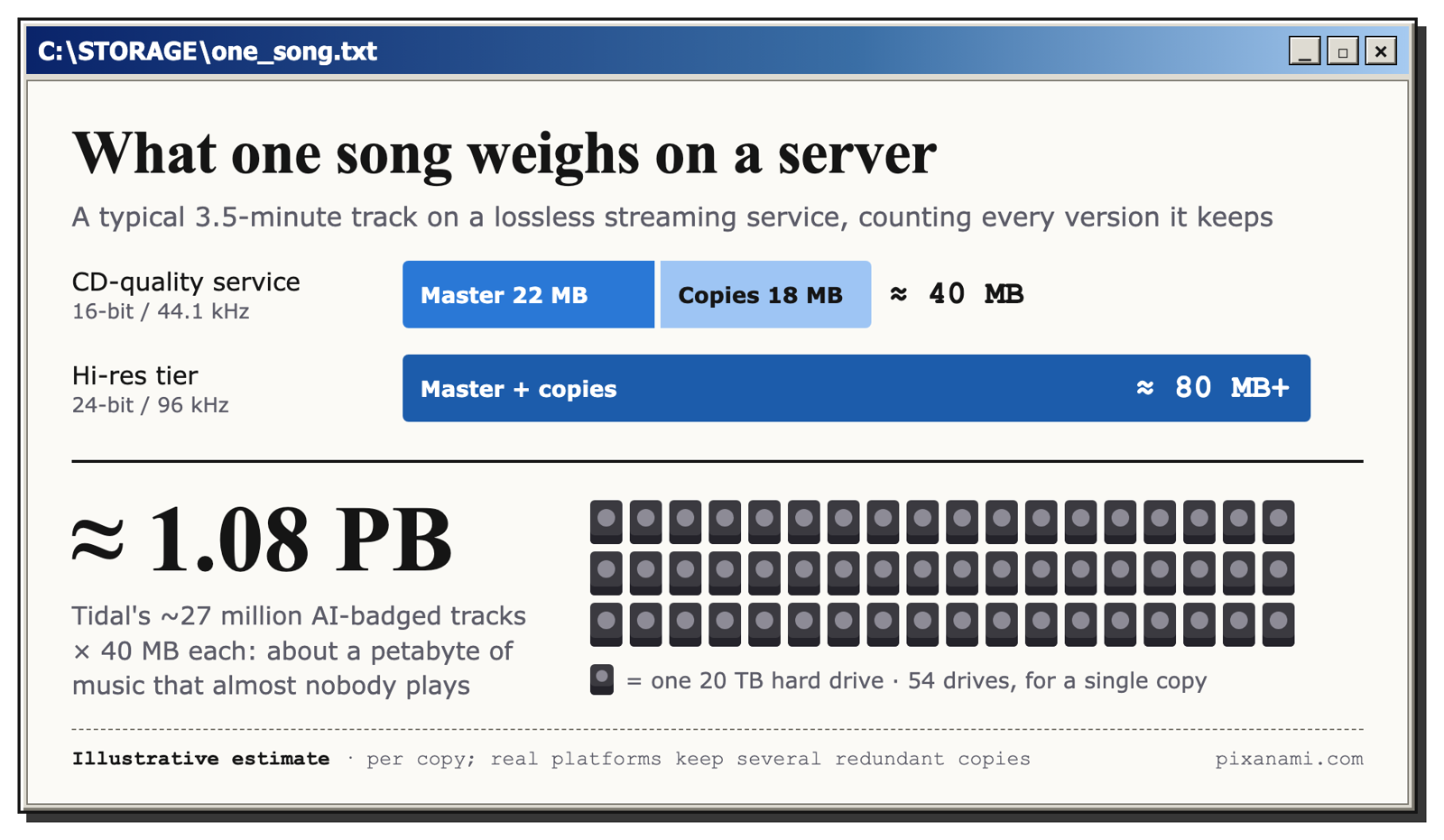
What one track costs to store. A typical 3.5-minute song stored as a lossless CD-quality FLAC master is roughly 20–25 MB. Streamers also keep several lossy transcodes for different quality tiers and devices, so call it about 40 MB per track all-in for a lossless service. Hi-res tiers (24-bit/96 kHz) can push that past 80 MB. And that's one copy. Real infrastructure keeps several redundant copies across data centers, plus CDN caches.
What Tidal is about to throw out. Tidal's ~27 million badged tracks × ~40 MB ≈ 1 petabyte of music that, per Tidal's own stats, almost nobody plays. If the purge happens, the ban could free up about a petabyte per copy.
What happens if nobody stops it. Take Deezer's ~90,000 AI tracks a day and assume the rate keeps doubling every year, which is slower than its actual growth over the past 18 months:
| Year | AI tracks/day | AI tracks added that year | Storage added (1 copy, ~40 MB/track) |
|---|---|---|---|
| 2026 | ~90,000 | ~33 million | ~1.3 PB |
| 2027 | ~180,000 | ~66 million | ~2.6 PB |
| 2028 | ~360,000 | ~131 million | ~5.3 PB |
| 2029 | ~720,000 | ~263 million | ~10.5 PB |
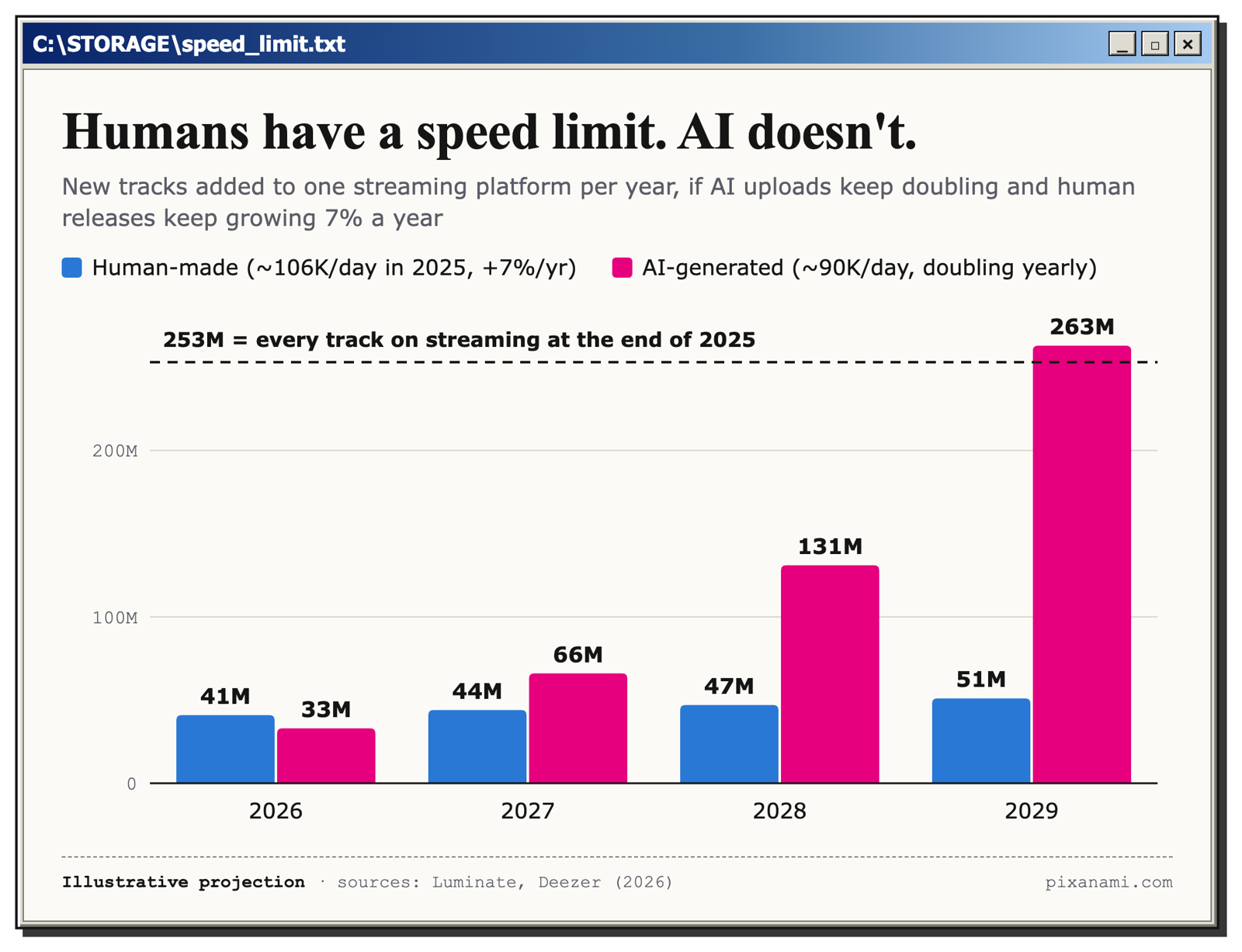
By 2029, a single platform would be taking in more AI tracks in one year than the entire recorded-music catalog held at the end of 2025. Four years of that adds up to roughly 20 PB for one copy, or around 60 PB with standard triple redundancy. At ballpark cloud object-storage prices of about $20 per terabyte per month, that's on the order of $5 million a year in storage alone for one copy, before bandwidth, transcoding compute, detection costs, or the moderation staff needed to sort it. And per Tidal's data, about 96% of it gets zero listens.
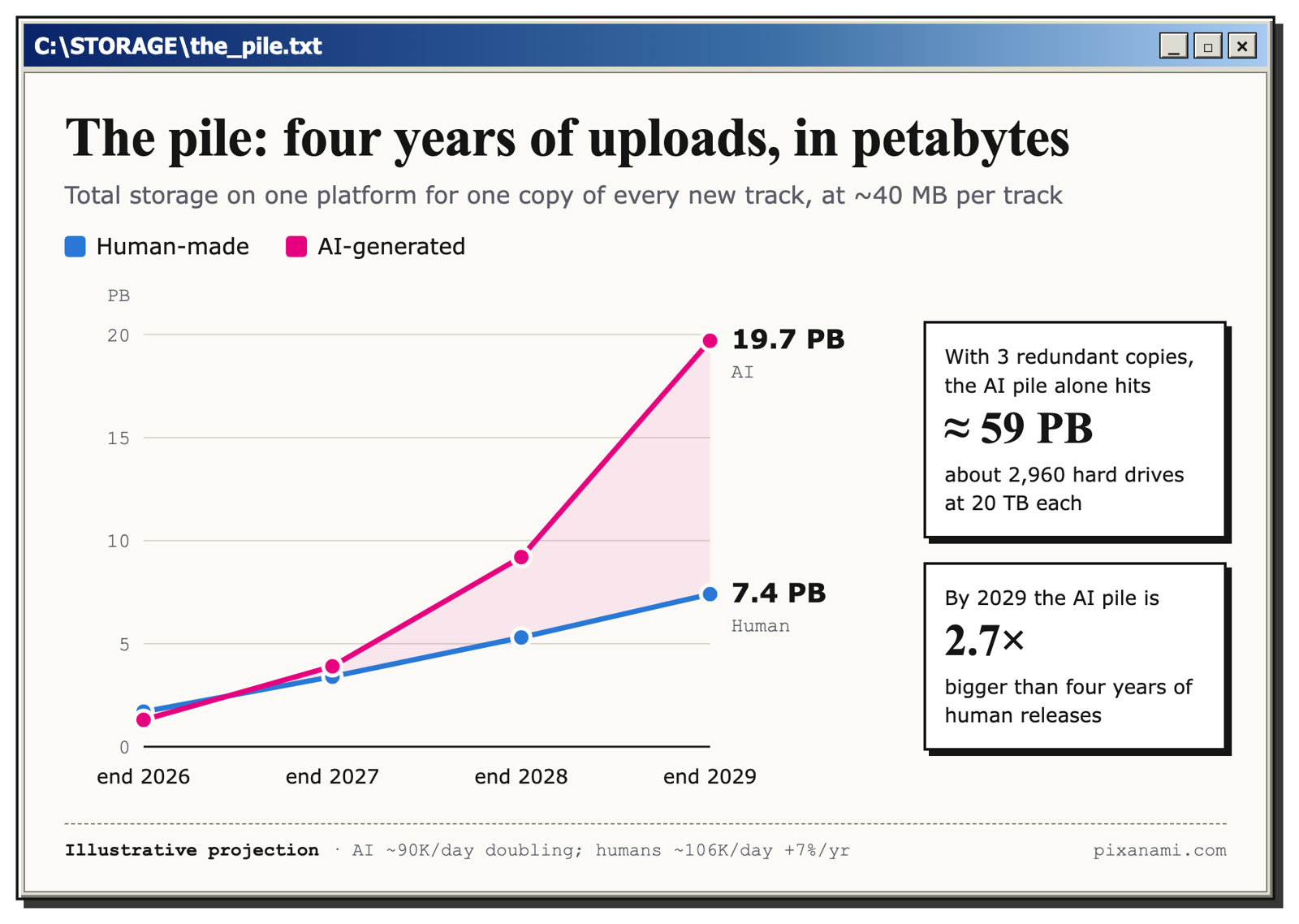
Compare that with human output. At ~106,000 tracks a day growing 7% a year, human releases add roughly 1.5–2 PB a year at the same 40 MB per track. That pace is steady and predictable, and it's tied to the number of people actually making music. AI uploads are tied only to how many GPUs someone is willing to rent.
That's why "label it and leave it" may not hold up. Demonetization takes away the payout, but it doesn't take away the storage bill, the slowdown in search, or the moderation load. Tidal seems to have run that math and decided the cheapest AI track is the one it never accepts.
What it means for working musicians
For artists, especially independents, the Tidal ban is mostly good news with one asterisk:
- Less noise in new releases. If almost half of incoming tracks disappear from Tidal's pipeline, human releases stop fighting slop for discovery.
- Fewer impersonators. Tens of thousands of fake tracks uploaded under real artists' names have already been pulled.
- The asterisk is false positives. No detector is perfect. An artist with an unusual, heavily processed, or electronic sound could get flagged. Ircam Amplify's claimed accuracy is impressive on paper, but even a tiny error rate across millions of tracks means some real musicians will get caught. How Tidal handles appeals will matter as much as the ban itself.
Tidal has always sold itself as the artist-first streamer, and this is the boldest move it's made on that promise. Whether Spotify, Apple, and Amazon follow, or keep betting that a little badge is enough, is the story to watch in 2027. For now, one major service has said out loud what a lot of musicians have been yelling for two years: making music should require someone to actually make it.