
How Many Cassettes to Order for Your First Release: The Math by Audience Size
The short answer: most artists should order 25 to 50 cassettes for a first release. Order 25 if your warm audience (email list, Bandcamp followers and the people who actually come to your shows) is under about 200 people. Order 50 if it's a few hundred. Order 100 only if you can realistically expect about 50–60 sales within six months, because that's roughly where a 100-tape run breaks even.
That's the rule of thumb. The rest of this guide shows the math behind it, so you can plug in your own numbers instead of guessing. Cassettes are cheap compared to vinyl, but a box of 80 unsold tapes under your bed is still money you won't see again, and it's a weirdly heavy thing to look at every day.
Why "how many followers do I have?" is the wrong question
Follower counts measure attention, they don't necessarily tell you who's gonna actually buy though. A tape is a physical object someone pays $10–$15 for, plus shipping, on top of a streaming subscription that already gives them access to your music. The people who do that are a small, specific slice of your audience:
- people on your email list, who asked to hear from you directly
- your Bandcamp followers, who are on a platform built around buying music
- people who see you play, especially at shows with a merch table
- friends and family, who will buy one no matter what (count them honestly)
Instagram, TikTok and Spotify numbers still matter, just far less per head. Ten thousand monthly listeners can sell fewer tapes than 200 email subscribers.
Step 1: Turn your audience into a sales estimate
Multiply each audience by a realistic conversion rate, then add them up. These are our ballpark estimates for a first physical release over about six months. They're rules of thumb, not published industry figures. We couldn't find any reliable public data on follower-to-tape conversion (obviously), so use the ranges and adjust to what you know about your fans.
| Audience | Mid rate | Realistic range | What counts |
|---|---|---|---|
| Email subscribers | 4% | 2–8% | Active list, (not a scraped one!) |
| Bandcamp followers | 5% | 3–10% | Followers of your artist page |
| Show attendance | 5% | 2–10% | Total heads across your shows in the sales window, not unique fans |
| Instagram / TikTok followers | 0.3% | 0.1–0.5% | Combined, minus obvious bots |
| Spotify monthly listeners | 0.1% | 0.05–0.2% | Mostly algorithmic plays, so it's the weakest signal |
| Friends and family | 50% | 30–80% | People you can actually name |
A sanity check on the show number: across big concerts, about one in five attendees bought merch in 2025, according to the merch platform atVenu (atVenu). That's any merch, at shows with real merch tables and tour-sized crowds. At small local shows, where many people are repeat attendees who already own your tape, 5% per head is a safer planning number.
Your low case is roughly half the mid estimate, and your high case is about double whatever that is. Plan around the mid, and protect yourself against the low.
Step 2: Know what each run really costs
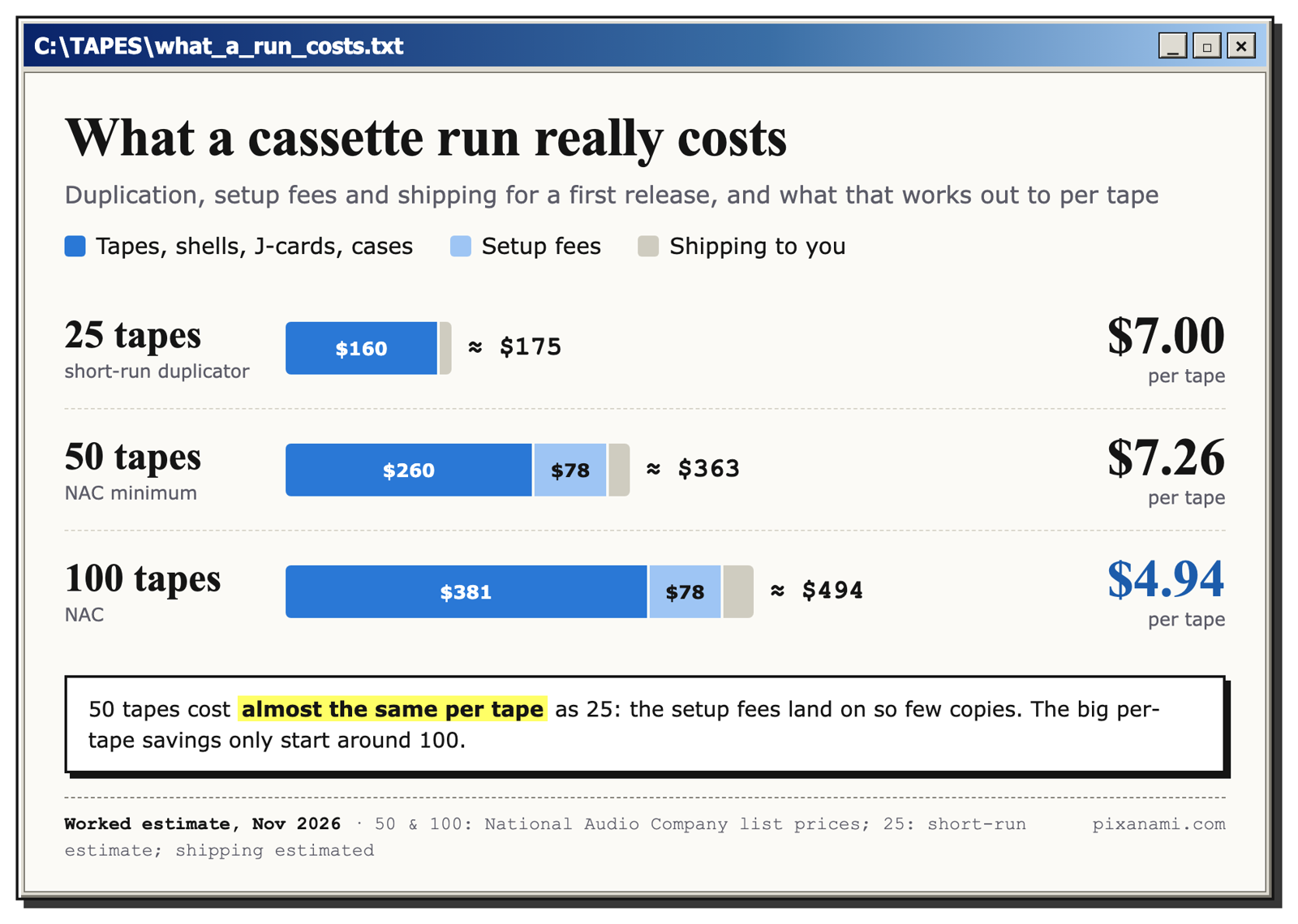
Here's a worked cost table for the three run sizes most first releases choose between. The 50- and 100-tape prices use National Audio Company's published calculator, which lists duplicated 40–44 minute tapes with full packaging starting at $260 for 50 and $381 for 100 (prices updated May 2026), plus a one-time $38 mastering fee and $40 graphics fee (National Audio Company). NAC's minimum is 50, so the 25-tape column is our estimate for a boutique short-run duplicator, based on published per-copy prices from smaller duplicators (Cassette Duplication Directory). Freight to your door is estimated too. Get real quotes before you order.
| 25 tapes | 50 tapes | 100 tapes | |
|---|---|---|---|
| Duplication, shells, J-cards, cases | ~$160 (short-run duplicator, estimate) | $260 | $381 |
| Setup fees (mastering + graphics) | usually included at this size | $78 | $78 |
| Shipping to you (estimate) | ~$15 | ~$25 | ~$35 |
| Total cost | ~$175 | ~$363 | ~$494 |
| Cost per tape | ~$7.00 | ~$7.26 | ~$4.94 |
| Giveaways (band, press, radio, ~10%) | 3 | 5 | 10 |
| Copies left to sell | 22 | 45 | 90 |
Notice the jump though! 50 tapes cost almost the same per tape as 25, because the setup fees are spread across so few copies. The big per-tape savings only start around 100.
Step 3: Find your break-even
Selling on Bandcamp, you keep the price minus Bandcamp's 10% share on physical goods and payment processing, which Bandcamp puts at roughly 4–7% for an average purchase (Bandcamp, Bandcamp fair trade policy). Shipping is charged to the buyer on top. Using 5% for processing, a $10 tape nets you about $8.50, and a $12 tape about $10.20.
| 25 tapes | 50 tapes | 100 tapes | |
|---|---|---|---|
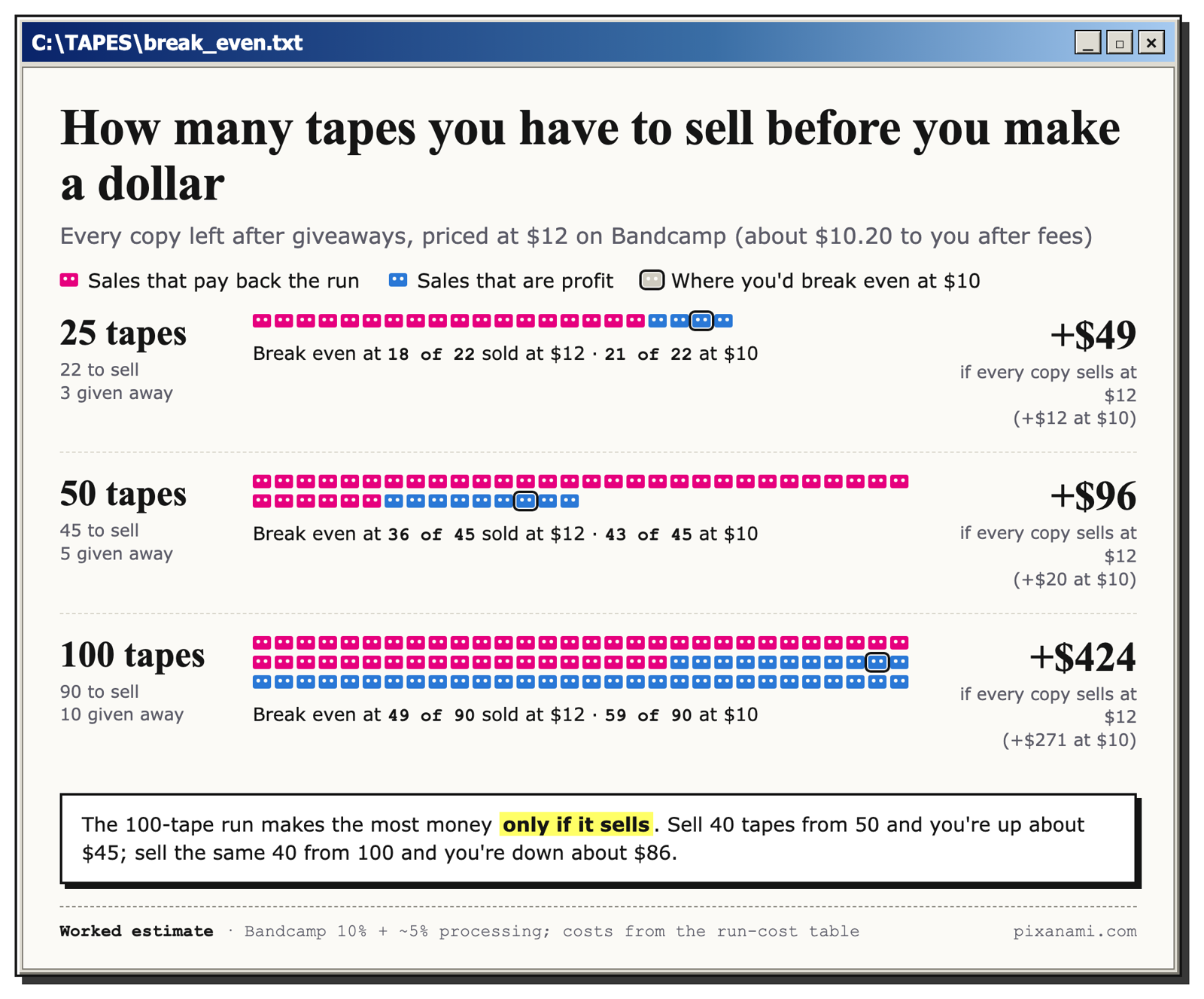
| Sales to break even at $10 | 21 of 22 | 43 of 45 | 59 of 90 |
| Profit if every copy sells at $10 | ~$12 | ~$20 | ~$271 |
| Sales to break even at $12 | 18 of 22 | 36 of 45 | 49 of 90 |
| Profit if every copy sells at $12 | ~$49 | ~$96 | ~$424 |
Two things jump out:
- At $10, small runs barely break even, even when they sell out. A sold-out run of 50 at $10 clears about twenty bucks. Pricing at $12 (with a free download code, which Bandcamp generates for you) roughly quadruples your margin on a small run without pricing out real fans.
- The 100-tape run is the most profitable only if it sells. Sell 40 tapes at $12 from a run of 50 and you're up about $45. Sell the same 40 from a run of 100 and you're down about $86, with 50 tapes left in a box.
That second point is the whole game. Ordering more saves money per tape but costs you money overall unless the extra tapes actually leave the house.
Step 4: Pick your run
The ordering formula:
Order your expected six-month sales (mid estimate) plus 10% for giveaways, rounded to the nearest standard run. Then check that your break-even is at or below your mid estimate.
Here's how that plays out for three typical first-release artists.
Example A: the first-timer
600 Instagram followers, 150 monthly listeners, 25 Bandcamp followers, no email list, three local shows of about 30 people each, and about 10 friends and family who'll definitely buy one.
| Audience | Size | Rate | Expected sales |
|---|---|---|---|
| 600 | 0.3% | 1.8 | |
| Spotify listeners | 150 | 0.1% | 0.2 |
| Bandcamp followers | 25 | 5% | 1.3 |
| Show attendance | 90 | 5% | 4.5 |
| Friends and family | 10 | 50% | 5 |
| Total | ~13 |
Order: 25. Thirteen plus a few giveaways rounds to the smallest run. At $12 the break-even is 18, so expect this run to sell out slowly or land a little short. Treat it as a calling card for the merch table, not a profit center. If even 25 feels like a stretch, dub 10–15 yourself in real time on a deck and see how fast they go.
Example B: the local regular
2,500 Instagram followers, 800 monthly listeners, 150 Bandcamp followers, 300 email subscribers, six shows of about 50 people in the next six months, and 10 friends and family.
| Audience | Size | Rate | Expected sales |
|---|---|---|---|
| Email list | 300 | 4% | 12 |
| Bandcamp followers | 150 | 5% | 7.5 |
| 2,500 | 0.3% | 7.5 | |
| Spotify listeners | 800 | 0.1% | 0.8 |
| Show attendance | 300 | 5% | 15 |
| Friends and family | 10 | 50% | 5 |
| Total | ~48 |
Order: 50. Forty-eight plus giveaways lands right on a 50 run, and the $12 break-even of 36 sits comfortably below the mid estimate. A run of 100 would need 49 sales just to break even, basically the whole mid estimate, so it's a coin flip. Sell out of 50, then repress. A "second pressing" is a better story than a discount bin anyway.
Example C: a small but real online audience
8,000 Instagram followers, 5,000 monthly listeners, 600 Bandcamp followers, 1,200 email subscribers, eight shows of about 60 people, and 10 friends and family.
| Audience | Size | Rate | Expected sales |
|---|---|---|---|
| Email list | 1,200 | 4% | 48 |
| Bandcamp followers | 600 | 5% | 30 |
| 8,000 | 0.3% | 24 | |
| Spotify listeners | 5,000 | 0.1% | 5 |
| Show attendance | 480 | 5% | 24 |
| Friends and family | 10 | 50% | 5 |
| Total | ~136 |
Order: 100, with confidence. Even the low case (about 68 sales) clears the $12 break-even of 49. With this audience, the 100-tape run is clearly the better deal per tape, and 150 is reasonable if your duplicator offers it. Just don't jump to 300 because the per-tape price looks great. Your first release hasn't proven that demand yet.
Look at where the sales actually come from in Example C: the email list and Bandcamp followers produce more than half of them, while 5,000 Spotify listeners produce five. If you want to sell more tapes next time, build the list.
Ways to get more out of a small run
- Number them. "Edition of 50" on the J-card turns a small run into a feature instead of a limitation.
- Take preorders. A two-week Bandcamp preorder before you place the duplication order turns your estimate into real data. If preorders hit half of your mid estimate, you're on track.
- Always include a download code. Plenty of tape buyers don't own a deck. They're buying the object and supporting you, and the code means they can still listen.
- Price shipping honestly. In the US, cassettes can usually go USPS Media Mail, which costs $4.39 for the first pound after the July 2026 rate change (Pitney Bowes USPS rate chart), plus a padded mailer. Weigh a packed tape before you set Bandcamp's shipping rate.
- Bring them to every show. Physical merch sells best where people can hold it. Your merch table is the best sales channel you have.
Frequently asked questions
Is 50 cassettes too many for a first release?
Not if you have a few hundred people in your warm audience (email list, Bandcamp followers and regular showgoers). Fifty is the most common first run for active local artists. If your realistic estimate is under 25 sales, start with 25.
What's the minimum number of cassettes you can order?
It depends on the duplicator. National Audio Company, one of the largest US cassette makers, has a minimum of 50. Smaller short-run duplicators will often do 20–25, and you can always dub a handful yourself on a deck.
Is it cheaper to order 100 cassettes than 50?
Per tape, yes: about $4.94 a tape for 100 versus about $7.26 for 50 in our worked table. Overall, only if you sell more than about 50 of them. If you'd sell 40 either way, the bigger run loses money.
How much should I charge for a cassette?
Most independent tapes sell for roughly $8–$15. At $10, a small run barely breaks even after fees. $12 with a free download code is a good default for a first release.
How long should a cassette run take to sell?
Plan around six months. A run that sells out in a month means you can order more next time. A run that's half full after a year means your next order should be smaller, or your next release should come with a preorder.
Wrapping up
So yeah! Hopefully these numbers help make sense of the economics behind selling tapes and point you in the right direction if you plan on getting some made.
Cost and fee figures were checked in November 2026. Duplication prices change, so get a current quote before you order. If you're releasing music on tape, submit it to Pixanami. We love a good J-card.